Intent signals: first-party, third-party and why a person's own words beat a click
What counts as intent, where each kind comes from, what it can and cannot tell you and how to combine it with fit before you write to anyone.
Quick answer: Intent signals are evidence that a person or company is researching or discussing a problem you solve. First-party intent happens on your own channels, such as pricing page visits and demo requests; third-party intent happens elsewhere, such as research across publisher sites, comparisons on review sites and public posts. A person's own words, like a post asking which tool to use, beat an anonymous click and intent only counts on accounts that fit your buyer.
On this page 9 sections
Buyers do most of their homework before they talk to anyone. They read, compare, ask peers and post questions and each of those steps leaves a trace. Intent signals are those traces.
They are not all equal. This guide sorts them by where they come from, explains how intent data differs from public signals and shows why a sentence someone wrote beats a click someone made. It ends with a simple way to combine intent with fit, so you only write to people who are both interested and right for you.
What an intent signal is
An intent signal is any sign that someone is actively looking into a problem or a category: reading about it, comparing tools, asking for advice or visiting a vendor's site. It is different from a trigger event, which is a change in the business, and from fit, which is whether they could buy from you at all.
Intent matters because of timing. In 6sense's 2025 B2B Buyer Experience Report, a global study of nearly 4,000 B2B buyers, buyers initiated 79% of engagements with sellers and the point of first contact came 61% of the way through the buying journey. The winning vendor was already on the day-one shortlist 95% of the time.
The shortlist forms before the first call. Intent signals let you see the research while it is still happening and become one of the names on that list.
First-party intent
First-party intent happens on channels you own. You collect it yourself, so it is precise and it is yours.
- Website visits, especially to your pricing, comparison and integration pages.
- Demo requests and form fills, the clearest intent there is.
- Content downloads, webinar sign-ups and newsletter clicks.
- Product usage on a self-serve plan, such as teammates invited or a usage limit reached.
- Engagement with your own posts and company page on LinkedIn.
- Replies to your emails and messages.
Its reach stops at the people who have already found you and website visits stay anonymous until someone fills a form or a tool matches the visit to a company. Work it the same day: a quick answer to a demo request feels like service.
Third-party intent
Third-party intent happens on sites you do not own. It comes from three main sources.
Publisher and data co-ops
Networks of B2B sites pool what companies read, then report which accounts are researching a topic more than usual. Bombora's Company Surge, for example, scores company research against more than 25,300 topics, comparing the latest three weeks of activity with a 12-week baseline, using a co-op of publishers, brand sites and data providers. It works at the account level, with a separate add-on that shows who is driving the research. Pick a co-op source if you mainly want to know which accounts are reading about your topic across the B2B web.
Review sites
G2's Buyer Intent reports which accounts are viewing your product and category pages, comparing you with competitors, looking at pricing and reading reviews on G2. Pick a review-site source if you mainly want the accounts that are already comparing tools in your category.
Public social activity
People write about their work in public every day: posts about a problem, questions to their network, comments under a competitor's launch, a new job announced. It is third-party too, since it happens off your channels, but with one big difference: it comes with a name and, often, the person's own words.
Intent data vs public signals
"Intent data" usually means the first two sources: research activity measured across many sites and reported per account. "Public signals" means what named people do and say where anyone can see it. They answer different questions.
| Intent data | Public signals | |
|---|---|---|
| What you see | An account researching a topic more than usual | A named person's post, comment, new job or hiring push |
| Who | The company | The person, with their role |
| In whose words | A topic label | Their own |
| Best for | Choosing which accounts to focus on | Choosing who to write to and what to say |
| Next step | Find the right person at the account | Check fit, then write |
Teams that use both tend to treat intent data as the map and public signals as the knock on the door: one shows where to look, the other shows who is ready to talk.
Why a person's own words beat a click
A click is open to guesswork. The person on your pricing page might be a buyer, a student, a job seeker, a competitor or an investor doing research. A research surge might be one curious analyst. You are left to guess what it meant.
A sentence carries its meaning with it. Compare two signals from the same week at the same made-up company, Juniper Lane:
- The clicks: two visits to your pricing page from Juniper Lane's network and an account-level surge on "expense management".
- The words: the controller, Lena Ortiz, posts: "Still chasing receipts in group chats at every month-end. What are finance teams using for this?"
The clicks tell you to look at Juniper Lane. The words tell you who has the problem, how it feels, that she wants a tool now and the exact words to answer in. The first line almost writes itself:
Receipts in group chats at month-end is one of the most common setups we hear about and one of the easiest to change. Want the short version of how other controllers moved it out of chat?
Naming what someone wrote pays off from the first touch. Connection notes sent from the LinkedIn account of FOUND's founder were accepted 69% of the time when they named something the person had written, 29% when they were generic and 23% when there was no note.
How to combine intent with fit
Intent without fit is a distraction: a student researching your category has plenty of intent and no budget. Fit without intent is a cold list. Put the two together:
| Fit | Intent | What to do |
|---|---|---|
| Strong | Strong | Write today, starting from their words or the topic they researched. |
| Strong | Little or none | Stay visible: connect, post about their problem and watch for a signal. |
| Weak | Strong | Skip or point them somewhere useful. Interest alone does not make a buyer. |
| Weak | Little or none | Leave them out. |
- Write your buyer down first. Role, company type, size and region. Your website already describes them.
- Check fit before you score intent. Person and company both, every time.
- Score intent by strength and age. Words over clicks, this week over last month.
- Turn account signals into people. For an account-level surge, work out who owns the problem there, then look for a signal of their own.
- Stack them. Intent plus a trigger event, such as a new leader or a funding round, is the strongest case of all.
For how every kind of signal compares and ranks, see sales signals. For the fit check on a LinkedIn profile, see how to score a LinkedIn lead.
What to say for each kind of intent
How far along someone is decides the message. A person still reading wants something useful; a person asking for tools wants an answer. Either way, write about their problem, never about what you saw them do.
| Signal | What it suggests | Open with |
|---|---|---|
| Pricing page visit, account known | Comparing costs, maybe from a shortlist | The question buyers at that stage usually ask, such as how long setup takes |
| Research surge on your topic | Early reading, no shortlist yet | A short, useful point of view on the topic, with no ask |
| Comparing tools on a review site | A shortlist is forming | What to check when comparing and an offer to answer questions |
| Content download or webinar sign-up | Interest in one part of the problem | One idea on that part and a question about their setup |
| Post asking for recommendations | Ready to choose | A direct answer to their question, in their words |
| Comment describing the problem | Feels the problem, may not be shopping yet | Their point and one question about what they have tried |
Two rules hold for all six: one question per message and no line that tells them they were watched. Nobody warms to "I saw you on our pricing page".
How FOUND reads intent
FOUND is an AI SDR for LinkedIn that works from the public kind of intent. Every day it looks for people who write about the problem you solve, who engage with a competitor's posts, or who engage with your market's topics or your own page, alongside new roles, hiring and fresh funding.
Fit is checked before intent counts, twice per person: first the headline, then the whole profile. Every lead says, in one sentence, why it was picked and the note and messages build on what that person wrote or did. It finds each lead's verified work email and runs one sequence of LinkedIn steps and emails from your own mailbox, with replies from both in one inbox and an agent that can answer them. You teach it with "More like this", "Fewer like this" and "Not this person" and in review mode nothing goes out until you say so.
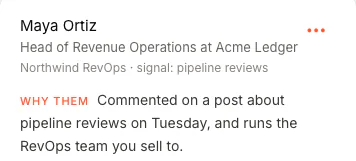
Try it on your own market: your first real leads arrive before you pay. Watch the demo or see what it costs.
Questions
What are intent signals?
Evidence that a person or company is researching or discussing a problem you solve: visiting a pricing page, comparing tools on a review site, reading about a topic across publisher sites or asking about it in a public post.
What is the difference between first-party and third-party intent?
First-party intent happens on your own channels, such as your website, product, emails and LinkedIn page. Third-party intent happens elsewhere, such as publisher networks, review sites and public social posts. First-party is precise but only covers people who already found you; third-party reaches people who have not.
Can intent data tell you who to contact?
Most intent data is reported per account, so it tells you which companies are researching a topic. You still need to work out who owns the problem there, ideally with a signal of their own, before you write.
What is the strongest intent signal?
Someone in your target role asking, in their own words, which tool to use for the problem you solve. A demo request is just as strong, but it only comes from people who already found you.
How do you combine intent signals with fit?
Check fit first, then score intent. Strong fit with strong intent gets a message today. Strong fit with no intent gets a connection and a watch for the next signal. Strong intent with weak fit gets skipped, however keen it looks.