Gojiberry alternatives in 2026: five ways to reach buyers who are already looking
FOUND, staying with Gojiberry, doing it by hand, a contact database plus a sequencer, or hiring it out. What each one costs you, and who each one fits.
On this page 9 sections
Most people looking for a Gojiberry alternative already like the idea behind it: find people by what they do on LinkedIn instead of from a list, and write to them while it's still relevant. What they want is the same idea at a different price, with different controls, or with more or less of their own time.
So this compares the five realistic options, including staying where you are. We make one of them, so it's listed first and the disclosure is right below. The rest are approaches rather than brand names, because we only name a product when we can tell you where our facts about it came from, and when we checked.
The five at a glance
| Option | What you get | What it costs | Best for |
|---|---|---|---|
| FOUND | A signal-first agent on your own LinkedIn and inbox. Replies drafted, or answered on the threads you pick | $69 a month, after you've seen your leads | Founders running their own outbound |
| Gojiberry | The same idea, with CRM integrations and a connector for Claude and ChatGPT 1 3 | $99 a month for Pro 1 | Teams whose pipeline lives in HubSpot or Pipedrive |
| By hand | You watch LinkedIn and write every message yourself | No subscription. Your own time, every day | Your first twenty conversations |
| A contact database plus a sequencer | A large list of contacts, emailed and messaged in volume | Per seat and per credit, set by each vendor | Volume to accounts you already know |
| An SDR or an agency | A person runs outbound for you | A salary, or a monthly retainer | Teams with budget and an offer that already sells |
1. FOUND
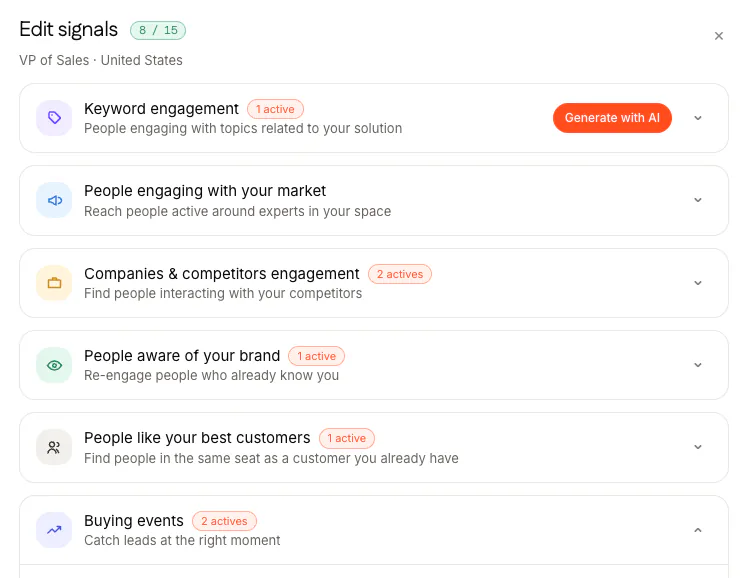
FOUND watches seven kinds of buying signal on LinkedIn, checks everyone they surface against your buyer twice, and writes to the ones who fit from your own LinkedIn and inbox. A reply stops their sequence and lands in one inbox with an answer drafted, offering your booking link once they're interested. On threads where you switch it on, the agent answers them itself; it's off by default.
What's different: you see real people for your own buyer, and the first message the agent would send, before you pay anything. After that it's $69 a month for two agents, one LinkedIn account and one mailbox, and a new account starts slowly, at 35 invitations a week.
Where it falls short today: no HubSpot or Pipedrive integration yet (webhooks, a Slack alert on each reply and CSV exports are there), no Claude or ChatGPT connector until our next release, no team logins, and no customer stories yet, because it's new.
2. Stay with Gojiberry
Sometimes the right alternative is none. Gojiberry is the better fit when:
- your pipeline has to sync to HubSpot or Pipedrive; it also connects to Instantly, Lemlist, Clay, Slack and Zapier [3];
- you want to run outreach from Claude or ChatGPT today [1];
- you want LinkedIn voice messages in your sequences, or profile visitors as a signal with Sales Navigator [3];
- you need EU hosting, which it says it has, or member seats for a team [1] [3].
What it costs: $99 a month for Pro with two agents [1], $59 a month for each extra agent and $99 a month for each extra member [3]. It says more than 2,000 sales and GTM teams use it [1].
The full side-by-side, fact by fact, is in FOUND vs Gojiberry.
3. Do it by hand
The signal-first method works without any tool, and doing it yourself for a few weeks is the fastest way to learn how your buyers talk. The routine:
- Pick three to five topics your buyers post about, in their words, not your category's.
- Each morning, open the recent posts on those topics with the most comments.
- Go through who reacted and who commented. Open the profiles that look like your buyer.
- Keep the ones who fit: the right role, company size and market. Note why each one is there.
- Write each a short note about the topic, not about the click. Never "I saw you liked this".
Where it breaks: it doesn't scale, it's the first thing to go in a busy week, and nothing keeps count of how many invitations you sent or when to follow up. For scale, FOUND's agent runs that routine on its own, taking one signal every six hours, and each time reads who engaged with the three most-engaged posts on the topic from the last two weeks.
4. A contact database plus a sequencer
The classic outbound stack: filter a large database by title, industry and company size, export the list, and send it through a sequencer by email and LinkedIn.
Good at: volume, and reaching a known set of accounts you've already chosen. Where it breaks: a list tells you who fits, not who is paying attention this week. The cost of cold volume lands on your sending domain and your LinkedIn account, and you still write, or template, every message. Prices are per seat and per credit and differ by vendor, so check each vendor's own pricing page on the day you buy.
You don't have to choose: import a list you already own into FOUND's Contacts, and the agent reads each person and only writes to the ones who fit your buyer.
5. An SDR or an agency
A person runs outbound for you: finds the accounts, writes, follows up and books the calls.
Good at: judgement, live conversations and follow-through. Where it breaks: cost and time. A salary or a retainer arrives before the first reply, a new hire takes weeks to learn your market, and they still need a way to know who is worth calling this week. That last part is what signals are for, whoever ends up doing the talking.
What to check before you pay for any of them
Seven questions to ask of any tool that sends from your LinkedIn account, with FOUND's answers so you can hold us to them.
| Ask | FOUND's answer |
|---|---|
| Can I see real leads for my own buyer before I pay? | Yes. The preview comes before checkout. |
| Does every lead say why it's there? | Yes, in plain words, on every lead. |
| Are the sending limits written down? | Yes: 35 invitations a week to start, one step up per two clean weeks to 125 (never more than 25 a day, Monday to Friday), a 72-hour pause and a step down if LinkedIn pushes back. |
| Does a reply stop everything else going to that person? | Yes, at once, on LinkedIn and email. |
| Is my LinkedIn password stored anywhere? | No. It passes through our server once, straight to our connection provider, and is never stored or logged. |
| What happens after a reply? | A drafted answer always, and the agent answers on threads you switch on (off by default). |
| Can I cancel in the app? | Yes, any time, in Settings. Your agents run to the end of the month you paid for. |
How we compared
For Gojiberry we used its public website (checked 24 Sep 2026), its help centre (read 20 Sep 2026) and its 31-minute tutorial video (reviewed 20 Sep 2026). For FOUND we used our own product and its code. The three other options are described as approaches, from how they work, with no prices or results we can't source.
We didn't run any of the five side by side, so nothing here claims a reply rate or a lead count for any of them. Spotted something out of date? Write to hello@foundtofind.com.
Questions
What is the cheapest alternative to Gojiberry?
Of the signal-first agents we can source, FOUND, at $69 a month against Gojiberry's $99 (its website, 24 Sep 2026). Doing it by hand costs no subscription, only your time.
Is there an alternative that answers replies for me?
FOUND's agent answers replies on the threads you switch it on for. It's off by default. It answers in your name at a human pace, offers your booking link once they're interested, never proposes a meeting time itself, and hands the thread back when they ask something only you can answer.
Can I see FOUND work before paying?
Yes. Sign in with Google, paste your website and connect LinkedIn. In about two minutes you see the real people the agent found for your buyer and the first message it would send the top one. You decide after that screen.
Why don't you list more tools?
Because a comparison is only as good as its facts. We name a tool once we've checked its prices and features ourselves and can tell you the date. Lists of a dozen tools with prices nobody dated go stale in weeks.